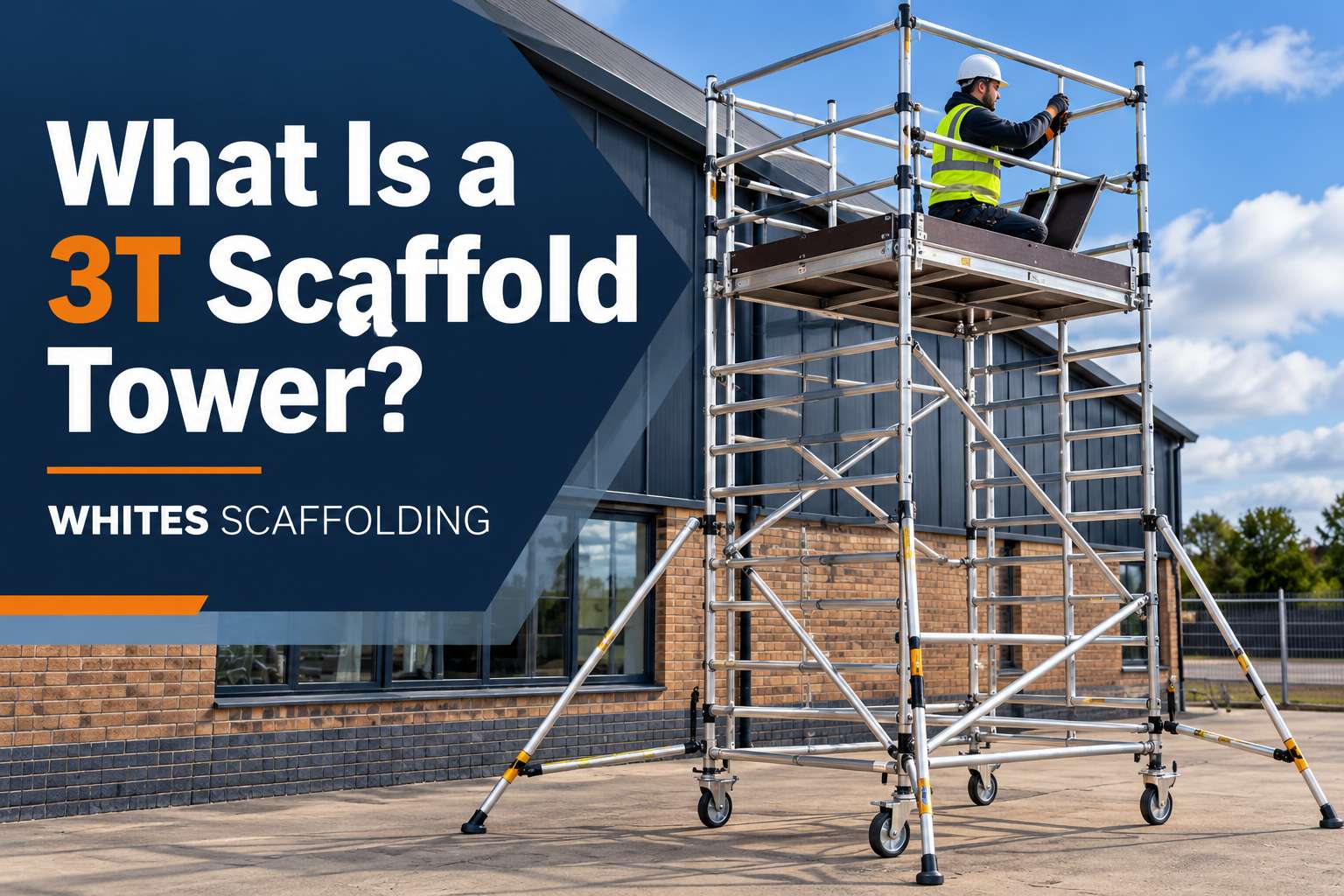
A 3T scaffold tower is a mobile access tower assembled using the Through the Trapdoor method, which allows guardrails to be installed before the worker stands on the next platform. The HSE and PASMA recognise it as a way to reduce falls during erection and dismantling.
Unlike a conventional scaffold built around a building, a mobile tower provides a compact working platform that can be repositioned when the ground and surrounding conditions permit. Its safety depends not only on the finished structure but also on how workers assemble and access it.
Understanding 3T helps contractors and property owners identify suitable equipment and ask the right questions before work begins.
What Does 3T Mean in Scaffolding?
3T means Through the Trapdoor, sometimes shortened to Through the Trap. It describes the erection and dismantling method rather than a particular tower brand, frame material or load rating.
During assembly, the operative takes a protected position in the opening of a purpose-designed trapdoor platform. From that position, they fit the horizontal braces that provide guardrail protection around the platform. Only after the required protection is in place do they move fully onto that working level.
A suitable tower is designed with the platforms, braces and internal access required to make that sequence possible.
A 3T tower is not automatically safe because it has a hatch. Its components must be compatible, its instructions followed and its base properly supported.
Why Was the 3T Assembly Method Developed?
The most obvious danger when building a tower is exposure to an open edge before fall protection has been fitted. Reaching across an unprotected platform to connect guardrails can leave an assembler vulnerable, especially while handling components at height.
The 3T method addresses this stage of the work. By positioning the worker inside the platform opening, it provides a more protected working position while the next guardrails are installed or removed.
Other risks remain. Incorrectly placed braces, an unstable base, missing stabilisers or a worker climbing the outside can still lead to serious incidents. A safe erection method therefore forms one part of a wider system involving competent operatives, suitable equipment and inspection.
How Does the 3T Method Work?
The precise sequence depends on the tower manufacturer and model. The following is an explanation of the principle, not a substitute for the equipment’s assembly manual or competent training.
Establish a stable base. The assembler checks that the ground can support the tower and that the permitted castors, frames, braces and stabilisers are positioned according to the instructions. The tower must be level and protected against unwanted movement.
Install the trapdoor platform. The correct platform is fitted at the specified stage, with the means of internal access available. The worker approaches the level through the tower rather than climbing its outside.
Fit guardrails from the trapdoor. Remaining in the protected opening, the assembler installs the horizontal braces intended to form the guardrails. The exact brace positions and order are specified by the manufacturer.
Access the protected platform. Once the prescribed components are correctly secured, the worker can enter the platform and continue with the next authorised stage. Dismantling reverses the protected process.
What Is the Difference Between 3T and AGR Towers?
The HSE and PASMA recognise two principal safe systems for assembling and dismantling standard mobile access towers: 3T and advance guardrail, usually called AGR.
3T: The operative works from the trapdoor opening to install the guardrail braces before standing on the platform. The method uses the tower’s specified components and construction sequence.
AGR: Specially designed guardrail units are positioned in advance from a lower, protected level. When the operative moves onto the next platform, its edge protection is already installed.
Neither label is a guarantee against every fall or stability hazard. Both approaches depend on correct equipment, competence and the manufacturer’s instructions.
When choosing a tower, ask which system it uses and whether the people assembling it are trained for that particular arrangement. A worker familiar with one model should still check the instructions for another.
What Components Does a 3T Tower Have?
Most commonly used 3T mobile towers are modular aluminium structures. Some access tower systems use other materials, including glass-reinforced plastic, where the application and equipment specification call for them.
Typical components include:
- Frames: Upright sections that form the tower structure and may incorporate ladder access.
- Horizontal and diagonal braces: Components that contribute to stability and, in the appropriate positions, guardrail protection.
- Trapdoor platforms: Purpose-built decks with openings for controlled internal access.
- Guardrails and toe boards: Measures that help prevent falls of people and materials.
- Castors and adjustable legs: Components for mobility and permitted levelling adjustments.
- Stabilisers or outriggers: Equipment used where specified to increase resistance to overturning.
Components that look similar are not necessarily interchangeable, and missing parts should never be replaced with makeshift alternatives.
How Wide and High Can a 3T Scaffold Tower Be?
3T refers to assembly, so it does not establish one standard footprint or maximum working height. Common aluminium towers are offered in narrow, approximately 0.85-metre, and wider, approximately 1.45-metre, configurations. Platform lengths vary by manufacturer and may include sizes around 1.8 to 3.2 metres.
For standard mobile access towers, BS EN 1004-1:2020 covers platform heights up to 8 metres outdoors and 12 metres indoors. Those are the scope limits of that particular standard, not permission to assemble every product to either height. Specialist arrangements outside its scope may be covered by other relevant standards.
Working height is often quoted as roughly two metres above platform height to describe a person’s reach, but actual safe access depends on the task and should not involve overreaching.
Always use the manufacturer’s permitted configuration, including the correct stabilisation for the proposed height and location.
How Much Weight Can a 3T Tower Hold?
There is no universal 3T load capacity. The safe load depends on the tower’s model, platform dimensions, load class and complete configuration.
Some industrial tower manuals specify a maximum evenly distributed load of 275 kg on an individual platform and an overall tower load figure of 950 kg. These are model-specific examples, not figures that should be applied automatically to another tower. The tower’s own weight may also need to be deducted when calculating the available payload.
Under BS EN 1004-1, platform load classes are expressed as uniformly distributed loads per square metre. The rated load needs to account for workers, tools and materials, not simply the number of people standing on the deck.
If the work demands a larger loading area or several trades, a different access arrangement may be more appropriate.
Where Are 3T Scaffold Towers Used?
A properly selected mobile access tower can be useful where the work is concentrated in a limited area and the equipment can be installed on suitable ground.
Common applications include:
- Internal painting and ceiling maintenance.
- Lighting, electrical and mechanical installations.
- Localised gutter and fascia repairs.
- Window and façade inspections.
- Warehouse and commercial property maintenance.
- Decorating, cleaning and small building repairs.
For tasks requiring several changes of working position, our mobile scaffold tower service provides an access option to consider alongside the wider needs of the site.
However, a tower is not always the most practical choice. Whole-roof replacements, extensive rendering and work along long elevations often need continuous access, different load capacities or additional edge protection.
Can a 3T Tower Be Used on Uneven Ground?
Only where the ground can provide a firm, stable and suitably level base within the limits of the specific tower system. Adjustable legs can accommodate permitted differences in level, but they do not make a steep slope, soft soil or broken paving automatically suitable.
Our guide to setting up a scaffold tower on uneven ground discusses the importance of ground bearing conditions, correctly supported castors and approved levelling arrangements.
Loose bricks, blocks, offcuts and improvised packing must not be used to raise one side of the tower. Stabilisers also need proper support at each contact point.
If the ground cannot support the tower correctly, stop and consider another access solution. The 3T method reduces exposure to unguarded platforms during assembly; it cannot compensate for an unstable foundation.
Can You Move a 3T Tower After Assembly?
Mobility is one of the practical advantages of many access towers, but moving one is a separate task that requires care. Before moving, remove people and materials, inspect the route and confirm there are no overhead hazards.
HSE guidance says a tower should be reduced to a maximum height of four metres before movement and moved manually from its base only. It must not be moved in strong winds or across unsuitable ground.
After repositioning, check the level, wheel locks, stabilisers and required configuration before anyone climbs back onto the platform. Never pull a tower from the top or move it while someone remains on it.
Where workers need access between several working levels, our stairs and scaffolding towers service offers other arrangements worth discussing.
Who Is Allowed to Assemble a 3T Scaffold Tower?
People who erect, alter, inspect, use and dismantle towers need to be competent for their responsibilities. PASMA’s Towers for Users course is a recognised route to learning safe tower assembly, use, inspection and dismantling, although the law focuses on competence rather than naming a single mandatory training card for every situation.
The operative must understand the particular model and follow its current instruction manual. HSE and PASMA both stress that instructions must be available and followed. A familiar-looking tower is not an invitation to guess the sequence.
Employers and site managers should check that the equipment is suitable for the task, workers have appropriate training and supervision, and the proposed method has been assessed.
Our scaffolding in Salisbury team can discuss the working height, available space and appropriate access equipment before installation.
What Checks Are Needed Before Using a 3T Tower?
Assembly is not the end of the safety process. The completed tower must be inspected by a competent person before use, with further checks at intervals appropriate to the work and following any event that could affect its safety.
For construction work where a person could fall two metres or more from a tower platform, HSE guidance specifies inspections following assembly and at least every seven days, with the required records maintained.
Check the ground, bracing, platform locks, guardrails, toe boards, access route, castor brakes and stabiliser arrangement. Damaged or incompatible components mean the tower should not be used until the problem is resolved.
Our article on whether scaffolding can be used on uneven ground explains why stability needs continuing attention rather than a one-off check.
What Are the Main Advantages and Limitations of 3T Towers?
The central advantage of 3T is protection during assembly and dismantling. It allows workers to install guardrail components from a safer position instead of standing on an exposed deck.
Mobile towers can also provide a relatively compact working area and, when conditions permit, the flexibility to move between short-duration tasks without installing a full elevation scaffold.
Towers need suitable ground, complete components, stabilisers and suitable height and load capacity. They do not provide the continuous access needed for every roofing, construction or refurbishment project.
The safest choice starts with the job rather than the equipment name. A 3T tower is valuable when it is the right tower, correctly assembled and used within its limitations.
Final Thoughts
A 3T scaffold tower uses the Through the Trapdoor method to install guardrails before the assembler steps onto the next platform. It is one of two recognised methods for reducing fall risks during mobile tower assembly and dismantling, alongside advance guardrail systems.
Tower dimensions and load limits come from the manufacturer, relevant standards and site conditions. Competent assembly, suitable ground, regular inspections and safe use remain essential.
At White’s Scaffolding, we can help you consider whether a mobile tower or another scaffolding arrangement best suits your property or project. Contact our team to discuss your access requirements and obtain a quotation.