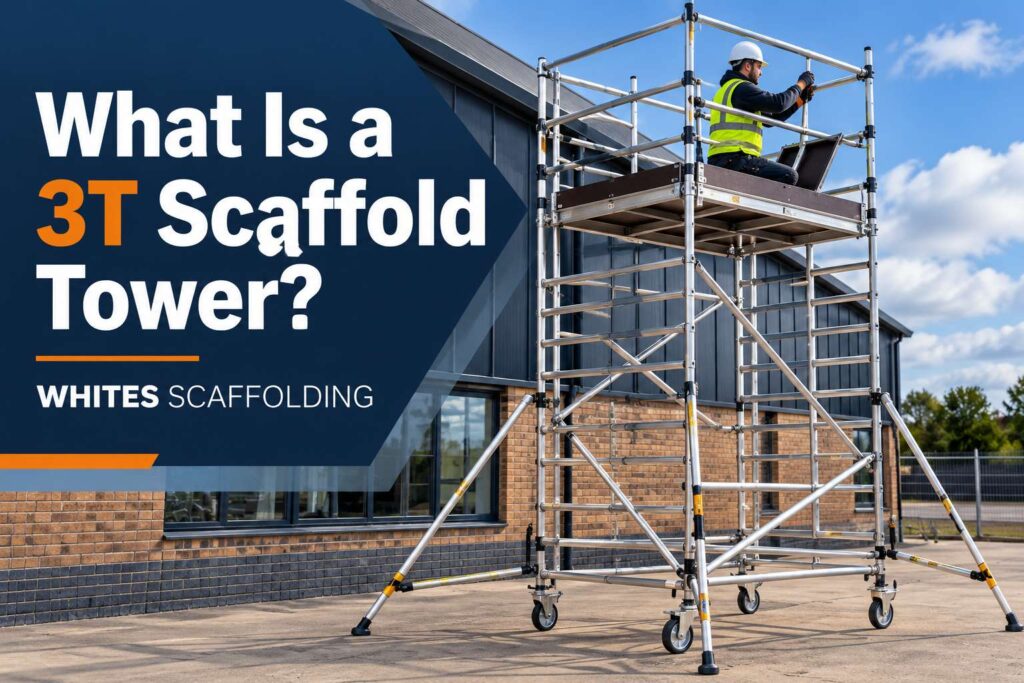
A scaffold tower should only be set up on uneven ground when the surface can be made firm, level and properly supported using equipment and adjustment methods permitted for that particular tower. Adjustable legs, base plates, castors and stabilisers can accommodate limited differences in level, but they should never be used to compensate for unsuitable or unstable ground.
If the ground cannot provide a safe, level base within the tower’s permitted setup, do not erect the tower there. A different access system or a professionally designed scaffold may be the safer option.
Uneven ground deserves particular attention because a relatively small difference at the base becomes increasingly important as the working platform rises.
Can You Put a Scaffold Tower on Uneven Ground?
Sometimes, but the key requirement is that the completed tower must be level, stable and properly supported.
Uneven ground might include:
- Sloping driveways.
- Patios with changes in level.
- Paved areas with uneven slabs.
- Gardens.
- Gravel.
- Steps.
- Sloping paths.
- Compacted soil.
- Ground beside extensions.
- Areas around drainage channels or inspection covers.
Some of these conditions can be accommodated safely. Others cannot.
Our guide to scaffolding on uneven ground looks more broadly at how ground conditions affect full scaffolds as well as towers.
The important point is that uneven ground should be assessed rather than simply packed underneath the tower until the platform appears level.
Start by Assessing the Ground
Before assembling anything, inspect the complete area where the tower and its stabilisers will stand.
The surface needs to support the combined load of:
- The tower.
- The working platform.
- The person or people using it.
- Tools.
- Materials.
- Stabiliser loads.
Look beyond what is immediately visible.
A surface may appear firm but contain weak areas underneath.
Potential problems include:
- Recently disturbed soil.
- Loose gravel.
- Broken paving.
- Hollow paving slabs.
- Drain covers.
- Underground voids.
- Soft lawn.
- Waterlogged ground.
- Cellars or basements below.
- Steep changes in level.
- Loose rubble.
If there is uncertainty about the bearing capacity or stability of the ground, the tower should not be erected until the problem has been properly assessed.
Clear the Setup Area
Remove anything that could prevent the tower components from sitting correctly.
This can include:
- Loose stones.
- Building rubble.
- Mud.
- Timber offcuts.
- Tools.
- Vegetation.
- Packaging.
- Debris.
You are not trying to reshape a significant slope manually.
The aim is to remove loose material and expose the actual supporting surface so its condition can be assessed.
If extensive excavation, filling or modification would be needed just to position the tower, that is a good indication that a tower may not be the most appropriate access method.
The Ground Needs to Be Firm as Well as Level
Level does not automatically mean safe.
A perfectly horizontal tower can still be unstable if one leg is standing on weak ground.
This is particularly important on:
- Soil.
- Grass.
- Gravel.
- Recently landscaped areas.
- Saturated ground.
- Old paving.
The weight from the tower travels through relatively small contact points at the base.
If one support starts sinking, the tower can gradually move out of level.
This is why ground bearing capacity matters just as much as levelling.
Never Use Bricks, Blocks or Makeshift Packing
Do not level a scaffold tower using whatever happens to be available on site.
Unsafe examples include:
- Loose bricks.
- Concrete blocks.
- Stacked paving slabs.
- Buckets.
- Plastic crates.
- Timber offcuts.
- Broken boards.
- Unsecured wedges.
- Tiles.
- Pieces of rubble.
These materials can crack, move, crush or slip.
Something that appears stable while the tower is empty may move once somebody climbs onto the platform.
Makeshift packing also makes it difficult to know how the load is being transferred into the ground.
What Are Adjustable Legs Used For?
Many tower systems use adjustable legs or similar levelling components.
These allow relatively small differences in ground level to be corrected so the tower can be made vertical and the working platform level.
They should only be used:
- With the tower they are designed for.
- Within the permitted adjustment range.
- In accordance with the tower instructions.
- On suitable supporting ground.
- Without improvising additional extensions.
An adjustable leg is not a licence to erect a tower on any slope.
The amount of permitted adjustment is limited.
If the change in ground level exceeds what the tower can safely accommodate, another access method should be considered.
Should the Lowest Point Have the Shortest Adjustment?
The aim is to achieve the correct tower configuration while keeping all adjustable components within their permitted ranges.
Do not assume that there is a universal sequence of extending one particular leg first.
Different tower systems use different base arrangements.
The correct approach is to follow the assembly instructions and make incremental adjustments until the base is level in both directions.
Check the Tower in Both Directions
A scaffold tower needs to be level from side to side and front to back.
A spirit level can help identify whether one side of the base is higher than another.
Check:
- Across the width.
- Along the length.
Do not rely only on eyesight.
A slight lean can become more significant as additional tower sections are added.
Levelling should therefore be established at the base before the tower is built higher.
What About Sole Boards?
On some ground conditions, suitable load-spreading support may be required beneath tower contact points.
However, there is no single sole-board dimension that can safely be specified for every mobile scaffold tower and every type of ground.
The appropriate arrangement depends on factors such as:
- Tower type.
- Base configuration.
- Ground condition.
- Load.
- Tower height.
- Instructions for the equipment being used.
The important principles are that the support must be sound, stable, capable of carrying the load and unable to move unexpectedly.
Do not automatically take sole-board dimensions intended for one type of scaffold and apply them to every mobile tower.
Can You Put a Tower on Grass?
Grass itself is not the main issue. The soil beneath it is.
A dry lawn may feel firm but still compress significantly under concentrated loads.
Conditions can also change quickly after rain.
Before considering a tower on grass, assess:
- How firm the soil is.
- Whether the ground has recently been disturbed.
- Whether water collects there.
- Whether the surface slopes.
- Whether underground drains or voids are present.
If the legs or support system could sink, the tower should not be erected until a suitable solution has been established.
What About a Sloping Driveway?
A slight change in level may sometimes be accommodated by the tower’s approved adjustable components.
A substantial slope is different.
The steeper the gradient becomes, the greater the difficulty in obtaining a safe tower base while keeping every component within its permitted configuration.
There may also be a risk of:
- Castor movement.
- Stabiliser movement.
- Load shifting.
- Support sliding downhill.
- The tower becoming increasingly difficult to level as height is added.
If the tower cannot be correctly levelled and supported, it should not be used on the slope.
Do Not Assume Castors Make Uneven Ground Easier
Mobile towers often use castors because they allow the structure to be repositioned on suitable surfaces.
Castors do not solve uneven-ground problems.
When the tower is in use, the wheels need to be properly supported and locked.
A castor sitting partly on a paving edge, loose gravel or an unstable surface does not provide an acceptable foundation simply because the wheel lock is engaged.
Castor condition should also be checked before assembly.
Lock Castors Before Building Higher
Where a mobile tower uses castors, they should be locked as required before the tower is assembled and used.
Trying to level or assemble a tower while the base is free to roll introduces unnecessary movement.
The base should remain stable while:
- Frames are added.
- Braces are fitted.
- Platforms are installed.
- Stabilisers are positioned.
- The tower is checked.
Our mobile scaffold tower service is designed around assessing these kinds of access, ground and stability requirements before the working platform is used.
Square the Base Before Adding Height
A tower should not be built upwards from a distorted base.
The first sections determine the alignment of everything above them.
Fit the required horizontal and diagonal bracing in the correct sequence.
Check that the base frames are:
- Properly connected.
- Square.
- Level.
- Stable.
- Fully supported.
Only then should additional sections be added.
A tower that starts slightly twisted or leaning should not be expected to correct itself as more components are installed.
Why Bracing Matters
Bracing prevents the tower frame from deforming and provides rigidity.
Missing braces can substantially affect stability.
Every required brace should be installed in the correct position during the assembly sequence.
Do not leave components out because:
- The tower appears rigid without them.
- A brace gets in the way.
- The job will only take a few minutes.
- The tower is not particularly high.
Tower systems rely on their complete set of structural components working together.
Fit Stabilisers or Outriggers Correctly
Stabilisers increase the effective footprint of the tower and help resist overturning.
Where they are required, all specified stabilisers should be installed.
Their exact:
- Position.
- Angle.
- Extension.
- Connection point.
- Ground contact.
should follow the instructions for the tower being used.
Do not make your own stabiliser arrangement to compensate for a slope.
In particular, do not assume that simply extending the downhill stabilisers further automatically makes a sloping setup safe.
The complete tower configuration needs to remain within its permitted design.
Every Stabiliser Foot Needs Proper Support
Stabilisers are only useful when they transfer load into suitable ground.
Check the surface beneath every foot.
A tower may have four perfectly supported castors but still be unsafe if one stabiliser is positioned on:
- Loose gravel.
- Soft soil.
- A broken paving slab.
- An unstable edge.
- A void.
The entire support footprint needs assessment.
Build the Tower Using the Correct Assembly Sequence
The safest assembly method is the method specified for the particular tower.
Do not improvise the sequence.
Assembly should allow guardrails and protected platforms to be installed without requiring the person building the tower to stand exposed on an unprotected level.
All necessary components should be available before assembly starts.
This includes:
- Frames.
- Braces.
- Platforms.
- Guardrails.
- Toe boards.
- Stabiliser equipment.
- Access components.
- Base components.
Do not substitute incompatible parts because the correct component is missing.
Never Mix Incompatible Tower Components
Components that look similar are not automatically interchangeable.
Differences in:
- Dimensions.
- Locking mechanisms.
- Connection details.
- Load capacity.
- Bracing geometry.
can make apparently similar pieces incompatible.
A tower should be assembled using components intended to operate together as a complete system.
Check the Working Height Before Building
Higher is not automatically better.
The working platform should provide safe access to the task without forcing the user to overreach.
Building unnecessary tower height can:
- Increase overturning forces.
- Increase exposure to wind.
- Require different stabilisation.
- Make access more difficult.
- Introduce unnecessary risk.
Our guide to safe scaffolding height looks more closely at how the task and working position influence the height required.
Do Not Exceed the Permitted Tower Height
The maximum safe height depends on the tower configuration.
Do not add extra frames simply because the work is still out of reach.
The permitted height may depend on:
- Whether the tower is indoors or outdoors.
- Base dimensions.
- Stabiliser arrangement.
- Wind exposure.
- Component configuration.
If the job is beyond the safe working range of the tower, use a different access arrangement.
Fit Guardrails and Toe Boards
A completed working platform requires suitable fall protection.
This normally includes properly installed guardrails around exposed edges and toe boards where required.
Do not remove protective components because they make access to the work slightly less convenient.
The tower should provide a protected working position rather than simply a platform at the correct height.
Use the Intended Access Route
Climbing the outside of a scaffold tower changes the forces acting on the structure and exposes the user to an unnecessary fall risk.
Use the tower’s designed internal access system.
Depending on the configuration, this might involve:
- An internal ladder.
- A staircase.
- Trapdoor platforms.
For projects requiring frequent movement between levels, professionally installed stairs and scaffolding towers can provide a more suitable access arrangement than repeatedly climbing a basic tower.
Can You Move a Scaffold Tower on Uneven Ground?
A mobile tower should only be moved over ground that is suitable for moving it safely.
Uneven ground creates obvious additional problems.
Before movement, check for:
- Potholes.
- Kerbs.
- Gravel.
- Slopes.
- Soft areas.
- Debris.
- Overhead obstructions.
- Cables.
Never move a tower while people or loose materials are on it.
If the ground is unsuitable for safe movement, dismantling and rebuilding in the new position may be necessary rather than attempting to wheel the complete tower across it.
Never Pull a Tower from the Top
Where a mobile tower is moved, force should be applied low down at the base.
Pulling or pushing high up the frame increases the risk of overturning.
This matters even more on surfaces that are not perfectly smooth because a wheel can stop suddenly when it reaches an obstacle.
The momentum of the tower can then continue above the stopped castor.
Weather Can Change the Ground
Ground conditions are not permanent.
A setup that was suitable in dry conditions may become less reliable after prolonged rain.
Soft ground can:
- Compress.
- Erode.
- Become waterlogged.
- Allow supports to sink.
- Allow sole boards to move.
This means the base should not simply be forgotten once the tower has been assembled.
Inspect ground conditions while the tower remains in use.
Wind Matters Too
Tower stability is affected by wind.
Do not use a tower in conditions outside the permitted limits.
Wind can be particularly significant around:
- Building corners.
- Gaps between buildings.
- Exposed sites.
- Open countryside.
- Tall elevations.
Sheeting should never be added casually to a tower because it can dramatically increase the surface area exposed to wind.
What If One Leg Starts to Sink?
Stop using the tower.
Do not continue working and assume the movement will stop.
Movement at one support can mean the tower is no longer level and the loads are no longer being distributed as intended.
The cause needs to be identified.
Possible causes include:
- Soft ground.
- Saturation after rain.
- Broken paving.
- Support movement.
- A hidden void.
- Inadequate load distribution.
The tower should be reassessed and corrected by a competent person before being used again.
When Is a Full Scaffold Better Than a Tower?
A tower is not the right answer for every access problem.
A full scaffold may be more suitable where:
- The ground changes level substantially.
- The work extends across a large elevation.
- Several workers need access.
- Heavy materials are required.
- The work will continue for a long period.
- Roof edge protection is needed.
- The site has awkward obstacles.
- Greater working-platform space is required.
This is particularly relevant around residential buildings where a small tower may initially look simpler but does not provide enough access for the full job.
Uneven Ground Around Houses
Domestic sites commonly contain awkward ground.
Typical examples include:
- Sloping driveways.
- Garden steps.
- Patios.
- Conservatories.
- Flower beds.
- Narrow side paths.
- Raised terraces.
- Extensions.
- Drainage channels.
These are situations where the difference between a compact tower and a full scaffold needs careful consideration.
A tower can be useful for a focused task in a suitable position, while a full scaffold may provide a more practical solution for roofing, rendering or work across an entire elevation.
Urban Sites Can Create Different Problems
Uneven ground is not restricted to gardens and rural properties.
Urban work may involve:
- Kerbs.
- Sloping pavements.
- Basement lightwells.
- Loading areas.
- Ramps.
- Broken paving.
- Changes between public and private surfaces.
Our local scaffolding service in Frome deals with varied access conditions including older properties, sloping ground, restricted streets and different building layouts.
The access equipment needs to suit the individual site rather than forcing the same tower arrangement onto every property.
Who Should Assemble a Scaffold Tower?
The person assembling, altering, inspecting or dismantling a tower needs to be competent to carry out that work.
They should understand:
- The equipment.
- The assembly method.
- Stability requirements.
- Ground conditions.
- Height limitations.
- Stabilisers.
- Safe access.
- Inspection requirements.
Having all the correct components does not remove the need for competence.
The safety of a tower depends on how those components are assembled and used.
Inspect the Tower Before Use
Once assembly is complete, check the full tower before anybody starts work.
The inspection should consider:
- Base support.
- Level.
- Castor locks.
- Adjustable legs.
- Bracing.
- Stabiliser positions.
- Platforms.
- Guardrails.
- Toe boards.
- Access route.
- Connections.
- Ground conditions.
- Missing or damaged components.
A tower used for construction work may also require recorded periodic inspections depending on the working height and circumstances.
Recheck It After Conditions Change
A tower should be checked again if something occurs that could affect its safety.
Examples include:
- The tower being moved.
- Components being altered.
- Heavy rain.
- Strong winds.
- Impact from vehicles or equipment.
- Ground settlement.
- Damage to components.
Do not assume that because a tower was safe yesterday, nothing can have changed.
Signs a Tower Should Not Be Used
Stop and have the tower checked if you notice:
- A leaning frame.
- A platform that is no longer level.
- A castor sinking into the ground.
- Moving support boards.
- Loose stabilisers.
- Missing braces.
- Damaged frames.
- Water collecting around the base.
- Unlocked wheels.
- Cracked or moving paving.
- Excessive movement while climbing.
Do not try to solve structural concerns while somebody remains on the tower.
A Simple Pre-Use Check
Before using a tower on a site where ground levels vary, confirm that:
- The supporting ground is firm.
- The base is level in both directions.
- Every support point is stable.
- Castors are locked.
- Adjustable legs remain within permitted limits.
- All required braces are installed.
- Stabilisers are fitted correctly.
- Platforms are secure.
- Guardrails are complete.
- Toe boards are fitted where required.
- The internal access route is available.
- No incompatible components have been used.
- The tower height is within the permitted configuration.
- Weather conditions are suitable.
If any of these points cannot be satisfied, do not use the tower.
Can You Set Up a Scaffold Tower on a Steep Slope?
A steep slope is unlikely to be suitable for a conventional mobile tower simply because adjustable legs are available.
The greater the difference in level, the more difficult it becomes to create a correctly supported, level structure while remaining within the permitted tower configuration.
Trying to solve a major slope by:
- Fully extending one set of legs.
- Packing beneath castors.
- Building platforms beneath one side.
- Improvising stabiliser positions.
is not an appropriate solution.
A professionally planned scaffold or another access method may be required.
What Is the Most Important Rule?
Do not try to make the tower fit unsuitable ground.
Start with the ground and decide whether the tower can be safely installed there.
If it can, use the correct adjustable components, supports and stabilisers to achieve a firm and level base within the approved setup.
If it cannot, use a different access solution.
That approach is safer than starting with the assumption that a tower must be made to work regardless of the site conditions.
Final Thoughts
Setting up a scaffold tower on uneven ground starts with assessing whether the ground is suitable for a tower at all.
The finished tower needs to stand on firm, stable and properly supported ground. Adjustable legs can compensate for limited differences in level where the tower configuration permits them, but they should never be treated as a way of overcoming any slope.
Do not use loose bricks, blocks, paving slabs or improvised packing beneath the tower. Fit every required brace, stabiliser, platform, guardrail and access component, and keep adjustable parts within their permitted limits.
Most importantly, follow the assembly instructions for the tower being used.
Where the ground is too steep, soft, unstable or irregular to provide a safe level base, stop rather than improvising. A full scaffold or another professionally planned access solution may be more appropriate for the site.