Professional scaffold access for homes, shops, offices and building projects across Ealing.
- Residential and commercial scaffold systems.
- Access for single or multiple elevations.
- London enquiries: 020 7205 2798.

Professional scaffold access for homes, shops, offices and building projects across Ealing.
With over 15 years of experience in the scaffolding industry, White’s Scaffolding delivers quality workmanship and dependable service across Wiltshire, Hampshire, and Dorset.
From domestic homes and extensions to industrial and commercial sites, we provide safe, reliable scaffolding tailored to every type of project.
We offer realistic, transparent rates with no hidden charges, providing exceptional value and professional results from start to finish.
Our fully trained and insured team works to strict health and safety standards on every job, ensuring secure structures and complete peace of mind.
White’s Scaffolding provides scaffolding in Ealing for roofing, maintenance, decorating, refurbishment and construction projects.
Ealing contains a broad mixture of Victorian and Edwardian housing, apartment buildings, shops, offices and newer developments. Properties around Ealing Broadway, The Mall and New Broadway can require very different access arrangements from residential streets around Ealing Green and the surrounding neighbourhoods.
A straightforward repair may only need access to one elevation. Larger projects can require working platforms around the front, side and rear so several external areas can be reached during the same programme.
White’s Scaffolding has completed a front, side and rear elevation scaffolding project in Ealing on Carlton Road. The scaffold provided access for roofing, guttering, external refurbishment and decorating work.
That type of project demonstrates why the required elevations should be identified before erection rather than adding additional access once contractors are already on site.
Some properties cannot be scaffolded effectively using a simple rectangular arrangement.
Bay windows, projecting roofs, changes in building height, narrow gaps and decorative façades can all affect the position of standards and working platforms.
Traditional tube and fitting scaffolding can be configured around individual building shapes because tubes and fittings allow the structure to be adapted to the available space.
This can be useful for:
Ealing includes numerous conservation areas and older buildings, but conservation status does not itself dictate the scaffold type. The important factors are the building geometry, work being completed and suitable positions for supporting and tying the structure.
Commercial work can require scaffold access while the premises beneath it remain occupied or operational.
Ealing Broadway and the surrounding town centre include shops, offices, hospitality premises and mixed-use properties where contractors may be working above entrances, public areas or neighbouring businesses.
Commercial and industrial scaffolding can support:
The scaffold should be planned around the operating requirements of the property as well as the building work.
Customer entrances, service routes, deliveries, fire exits and pedestrian areas may all influence where the structure can stand and how work is separated from people below.
The required working height matters, but site access and the contractor’s tasks are equally important when deciding how the scaffold should be arranged.
Conventional scaffolding normally transfers its loads down to suitable ground-level support. That is not always practical.
A building may stand above an entrance, fragile structure, restricted yard or area that cannot be occupied by a conventional scaffold footprint.
Suspended scaffolding provides a specialist alternative where working access is supported from above rather than simply rising from the ground directly beneath it.
It can be considered where:
Suspended arrangements need appropriate structural assessment and suitable support points. They are therefore a specialist solution rather than a substitute for ordinary scaffolding on every restricted site.
Where conventional access is available and practical, that may remain the simpler option.
A scaffold can serve more than one contractor during a refurbishment, but it should be planned around their different requirements.
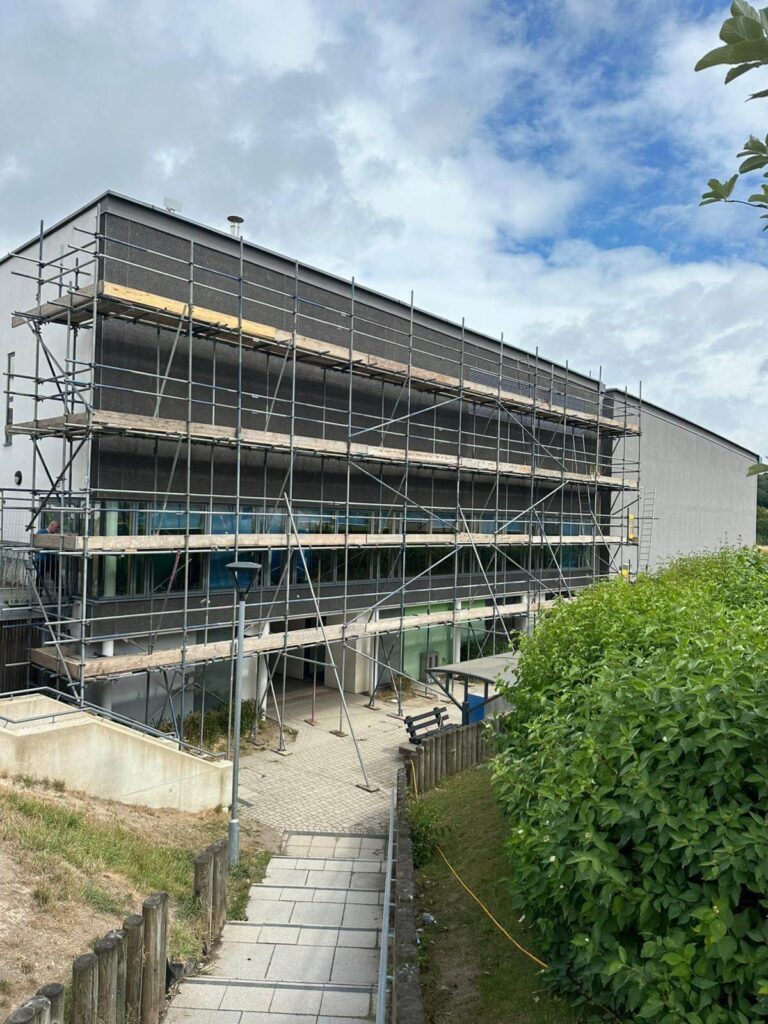
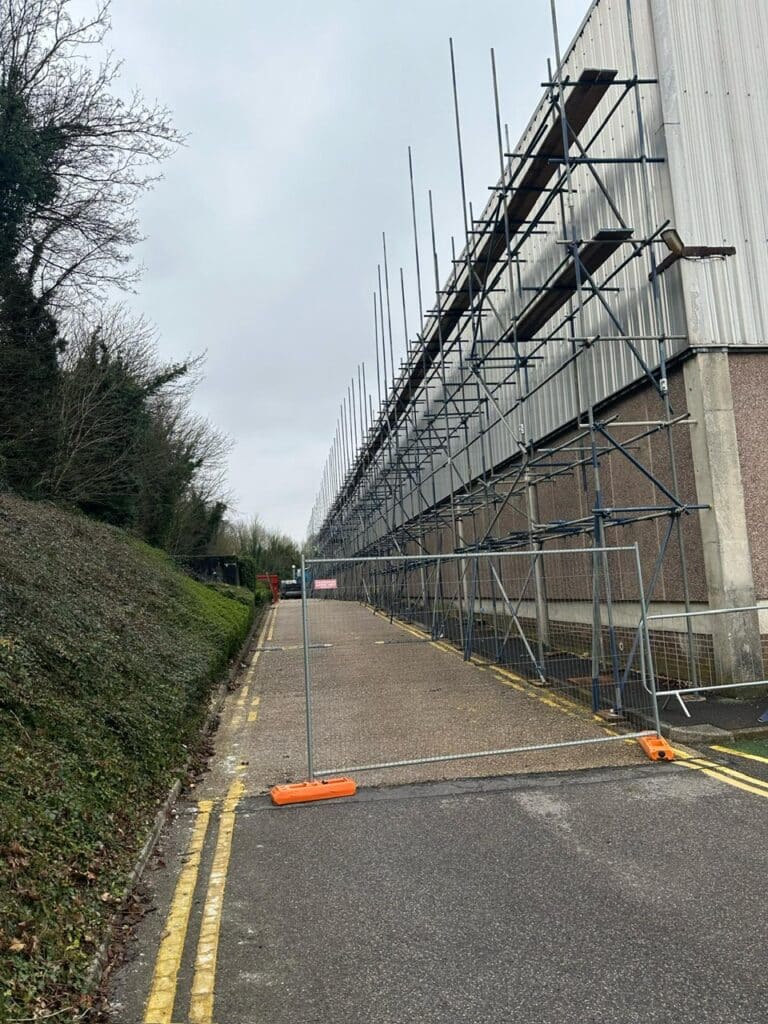
The Carlton Road project carried out by White’s Scaffolding supported roofing, guttering, refurbishment and decorating across three elevations. That combination illustrates how several trades can depend on the same access structure.
Before erection, it helps to establish:
A scaffold that is correct for roof access alone may not place a decorator or bricklayer at the ideal working height.
Coordinating these requirements before installation can reduce unnecessary changes and help the scaffold remain useful for the full duration of the project.
How much does scaffolding cost in Ealing?
The price depends on the dimensions, number of elevations, working levels, hire duration and access conditions. Specialist configurations or particularly restricted sites can require additional planning and affect the quotation.
Can scaffolding cover the front, side and rear of a house?
Yes. White’s Scaffolding has completed an Ealing project where access was provided to all three elevations for roofing, guttering, refurbishment and decorating.
Can scaffolding be erected on a Victorian or Edwardian property?
Yes. Older properties can be scaffolded, although bay windows, decorative façades, roof shapes and suitable tie positions may affect the configuration.
Can I scaffold only one part of my property?
Yes, where the work only requires localised access. There is no benefit in scaffolding unnecessary elevations unless they are required for safety, access or the planned work.
Do I need permission if scaffolding stands on the pavement?
Permission may be required where the scaffold occupies or projects over public highway land. The requirements depend on the exact site and relevant highway authority.
How early should scaffolding be booked?
Book early enough for the working areas and access restrictions to be assessed before the contractor intends to start. Complex or specialist arrangements may require more preparation than a straightforward house elevation.
Can builders alter the scaffold themselves?
No. Contractors using the scaffold should not remove ties, guardrails, boards or structural components. Any required alteration should be carried out by the scaffolding contractor.
Can a scaffold be changed after it has been erected?
Yes, where the project requires it. Changes may be needed when work moves to another level or the construction programme changes, but alterations should be planned and completed correctly.
What should I provide when requesting a quote?
Provide the property address, the work being completed, which elevations need access, the expected hire period and any obvious restrictions around the site.
How do I arrange scaffolding in Ealing?
Call White’s Scaffolding on 020 7205 2798 to discuss the building, planned work and required scaffold access.
Tell White’s Scaffolding which elevations need access, what work is planned and what restrictions surround the property. We can discuss a practical scaffold arrangement for your Ealing project.